
Invoice numbering sounds like a small detail—until it’s the reason a client pays the wrong invoice, a bank transfer can’t be matched, or your accountant asks why two different invoices share the same number. For small businesses, a clear invoice numbering system is one of those “boring” habits that quietly saves hours of admin and reduces payment confusion.
In 2026, the need for clean numbering is even more practical. Invoices are often processed by someone who doesn’t know you, and many companies use software that relies on invoice numbers to track approvals and prevent duplicates. If your invoice numbers are inconsistent, missing, or reused, your invoice may get flagged, delayed, or rejected.
This guide explains invoice numbering in plain language: what an invoice number is, why it matters, what formats work, and how to choose a system that fits a small business (including freelancers). You’ll also get real-world scenarios, examples you can copy, and a checklist.
Note: This article is general information. Record-keeping and tax rules vary by country. If you need compliance guidance, confirm requirements with your accountant or local tax authority.
What is an invoice number?
An invoice number is a unique identifier you assign to each invoice you send. It’s usually a short code made of numbers (and sometimes letters) that helps you and your client refer to a specific invoice without confusion.
For example:
- 2026-001
- INV-2026-0007
- QIT-24015
Invoice numbers matter because they make invoices traceable. When a payment arrives, you can match it to the correct invoice. When a client asks a question, you can reference one invoice instead of searching through email threads. When you do bookkeeping, it’s much easier to spot missing invoices or duplicates.
Why invoice numbering matters (beyond “being organized”)
1) Faster payment matching
If a client pays by bank transfer, their payment reference is often the invoice number. If you don’t have a clear invoice number—or your number is too long and gets truncated—the client may write something vague like “January services” and you’ll spend time matching it manually.
2) Fewer client-side processing problems
Many finance teams use the invoice number as the primary key in their system. If you send an invoice with the same number as one you sent last month, their system may reject it as a duplicate. That’s an easy way to lose a week without realizing why.
3) Better internal control and bookkeeping
If you track invoices in a spreadsheet or bookkeeping tool, invoice numbers help you ensure every invoice is recorded once and only once. A clean sequence makes it obvious if you skipped a number, duplicated one, or issued a correction.
4) Easier audits and compliance
Some jurisdictions expect invoices to be sequential or at least uniquely numbered. Even where the law is flexible, auditors and accountants strongly prefer a predictable system because it reduces the chance of missing records.
The two rules every small business should follow
Regardless of the format you choose, your invoice numbering system should follow two core rules.
Rule 1: Every invoice number must be unique
Never reuse an invoice number—ever. Even if you “cancelled” the invoice or made a mistake, reusing the number can create confusion later.
Rule 2: Your system must be repeatable
If you can’t explain your invoice numbering system in one sentence, it’s probably too complicated. You should be able to follow it even when you’re busy or tired.
A good one-sentence system looks like:
- “I use year + sequence, starting at 001 each year.”
- “I use INV + year + a 4-digit running number.”
Common invoice number formats (with examples)
There isn’t one “correct” format, but there are patterns that work well for small businesses. Choose a format that makes invoices easy to track and reduces mistakes.
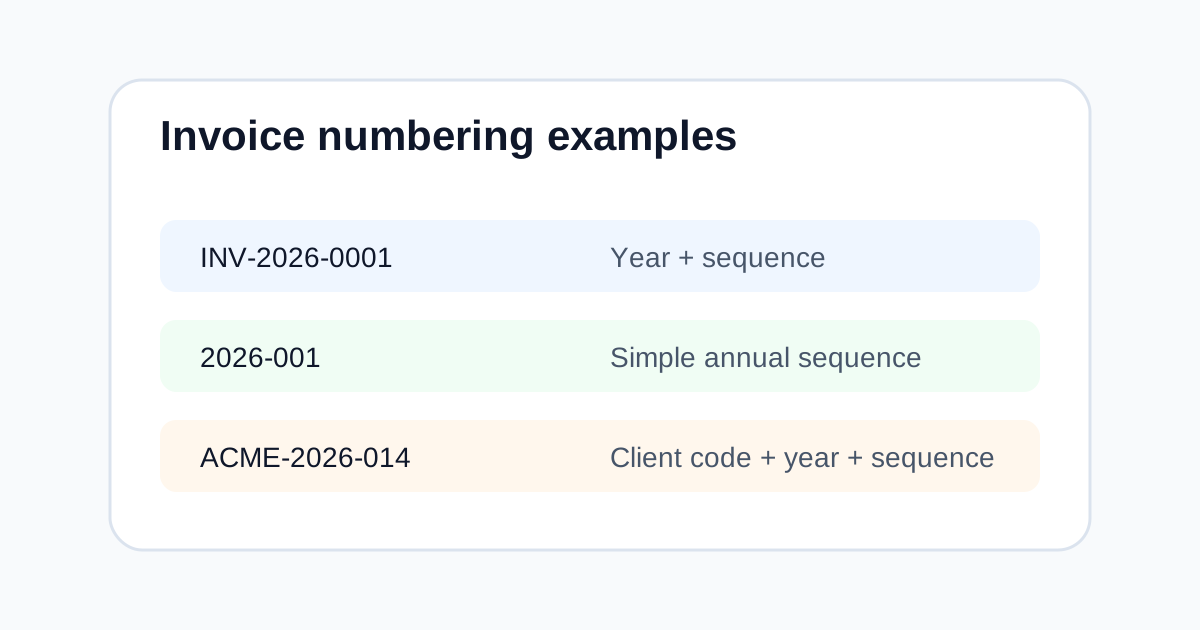
Format A: Year + sequence (simple and tidy)
Examples:
- 2026-001
- 2026-002
- 2026-003
Why it works:
- Easy to understand
- Sorts naturally by year
- Makes end-of-year reporting easier
Best for: freelancers, solo operators, small service businesses.
Format B: Prefix + year + sequence (more “formal”)
Examples:
- INV-2026-0001
- INV-2026-0002
Why it works:
- The prefix clarifies the document type
- Helpful if you also issue quotations, credit notes, or receipts
Best for: small companies that issue multiple document types.
Format C: Sequential only (works, but needs discipline)
Examples:
- 001
- 002
- 003
Why it works:
- Very simple
Trade-offs:
- Over years, numbers grow large
- Without a year, it’s harder to understand an invoice at a glance
Best for: businesses that only invoice one client type and keep everything in a single system.
Format D: Client code + sequence (use carefully)
Examples:
- ACME-001
- ACME-002
- NOVA-001
Why people like it:
- Helps group invoices by client
Why it can backfire:
- If you send invoices to many clients, it’s easy to accidentally reuse numbers across clients
- Some finance teams prefer a single global unique number
Best for: specific workflows where invoices are separated per client, and you are confident you will never create duplicates.
Format E: Date-based invoice numbers (usually not ideal)
Examples:
- 20260111-01
- 20260111-02
This can work, but be cautious:
- It’s easy to produce duplicates if you forget the “-01/-02”
- Some people later confuse date-based numbering with invoice dates
Best for: businesses that issue many invoices per day and want the date embedded, but still need a sequence to avoid duplicates.
Should invoice numbers be sequential?
Many small businesses use sequential invoice numbers because it’s the simplest way to stay organized. In some countries, sequential numbering is encouraged or effectively expected. In others, the main legal requirement is that numbers are unique and invoices are traceable.
If you can choose, sequential numbering is usually the best default because it has three practical benefits:
- It’s easy to maintain
- It makes missing invoices obvious
- It reduces the chance of duplication
If you have a strong reason to use a non-sequential system, make sure it still provides uniqueness and repeatability.
What happens if you skip an invoice number?
Skipping a number is common and usually not a disaster. It can happen when you draft an invoice and decide not to send it, or when you create an invoice and then correct it.
The key is: don’t pretend it didn’t happen by reusing the number. Instead, keep a record of why it was skipped. Depending on your process, you can handle it in one of these ways:
- Mark the invoice as “void” (not sent / cancelled) and keep it on file
- Issue a credit note and a new invoice if it was sent and needs correction
If you do bookkeeping software or you generate invoices as PDFs, saving the voided invoice (even if it’s just a draft copy) makes life easier later.
How to handle corrections, cancellations, and revisions
Small businesses run into these situations all the time. The goal is to keep the paper trail clear.
If you made a mistake before sending the invoice
- Correct the invoice
- Keep the same invoice number (because nothing was sent)
In your internal notes, you can store the draft you replaced, but it’s not strictly required if it was never issued.
If you sent the invoice and then discovered an error
Avoid reusing the invoice number for a “fixed version” without any explanation. Instead, do one of these depending on your accounting practice:
- Issue a revised invoice with a new number and reference the old invoice
- Issue a credit note (or adjustment note) and then issue a new invoice
Example approach:
- Original invoice: INV-2026-0012
- Credit note: CN-2026-0003 (credits the incorrect amount)
- Corrected invoice: INV-2026-0013
If you’re not sure which method is appropriate for your country, ask your accountant once and then standardize it.
If the client cancels the job after you issued an invoice
If the invoice was issued but the service won’t be delivered, you typically don’t “delete” the invoice. You keep it and issue a credit note (or mark it void if allowed by your system). The important part is preserving traceability.
Real-world scenarios (how invoice numbering plays out)
Scenario 1: freelancer with three recurring clients
A freelance writer works with three companies every month. They use a simple year + sequence system: 2026-001, 2026-002, and so on.
One client pays late and sends a bank transfer with the reference “2026-006”. The freelancer can match it instantly. In their spreadsheet, invoice 2026-006 is clearly overdue, and once paid it’s easy to update.
Result: less time chasing payments, fewer mistakes in records.
Scenario 2: small studio with quotations and invoices
A design studio sends quotations before work begins. They use a prefix system:
- Quotes: QUO-2026-0001
- Invoices: INV-2026-0001
When a project is approved, the invoice references the quotation number in a “Reference” field. The client’s finance team can match the invoice to the approved quotation without follow-up questions.
Result: smoother approvals and fewer disputes because the invoice aligns with what was agreed.
Scenario 3: trades business issuing multiple invoices per day
A small electrical company issues many invoices daily. They choose date-based numbering with a sequence to avoid duplicates:
- 20260111-01
- 20260111-02
- 20260111-03
Their office manager prints invoices as PDFs and files them by month. When they need to find an invoice from a specific day, the number makes it easy.
Result: faster retrieval and clearer daily tracking, as long as the team follows the same approach consistently.
Picking the right system: a practical decision framework
If you’re not sure where to start, this framework helps you pick a system that you’ll actually maintain.
Step 1: Decide whether you want a yearly reset
A yearly reset keeps invoice numbers short and adds clarity. For example, 2026-001 starts over each year.
Pros:
- Easy year-based reporting
- Cleaner sequences
Cons:
- You must include the year to avoid duplicates across years
Step 2: Decide whether you need prefixes
Prefixes are helpful if you issue multiple document types. If you only issue invoices, you can skip them.
Useful prefixes:
- INV (invoice)
- QUO (quotation)
- CN (credit note)
- REC (receipt)
Step 3: Choose a sequence length
Using leading zeros helps sorting and readability.
- Small volume: 001, 002, 003
- Medium volume: 0001, 0002, 0003
Pick something that matches your volume and stick to it.
Step 4: Write your rule down
It sounds silly, but writing the rule down prevents “future you” from improvising. Example:
- “Invoice numbers are INV-YYYY-####, starting at 0001 each calendar year.”
Invoice numbers vs quotation numbers (and why both matter)
Many small businesses mix up the identifiers for different documents. A clean approach is to give every document type its own numbering series.
- Quotation number: identifies a quote before work starts
- Invoice number: identifies the payment request
- Receipt number: identifies proof of payment (if you issue receipts separately)
If you use an invoice generator, numbering is often handled automatically, which reduces mistakes and makes your sequence consistent. If you send quotes often, a quotation generator can help you keep quotation numbers tidy too, and it makes it easier to reference the quote later on the invoice.
The key is consistency: a quotation number should never be used as an invoice number, and vice versa.
Best practices (small habits that prevent big headaches)
Keep one “source of truth”
If you create invoices in multiple places (a spreadsheet sometimes, a PDF template other times, and software occasionally), you will eventually create duplicates. Pick one system and stick to it.
Avoid editing old invoice numbers
Once an invoice number is issued and sent, don’t change it. If something needs correction, handle it via a documented correction process (revised invoice, credit note, etc.).
Store invoices in a predictable folder structure
For example:
- Invoices/2026/
- Invoices/2026/January/
Even if you use software, having a simple filing structure makes ad-hoc retrieval easier.
Include the invoice number in your email subject
A small trick that reduces confusion:
- “Invoice INV-2026-0017 — Due 25 Jan 2026”
It helps clients find your invoice later, and it makes your follow-ups feel clearer and more professional.
A simple checklist you can reuse
Before you send an invoice, confirm:
- The invoice number is unique
- The invoice number matches your format rule
- The invoice date and due date are correct
- If this invoice relates to a quote, the quotation number is referenced
- If you corrected a previous invoice, the correction method is documented
FAQ
Do invoice numbers have to be sequential?
Not always, but sequential numbering is the simplest and most common approach for small businesses. Some jurisdictions expect sequential invoices for auditability. At minimum, invoice numbers should be unique and traceable.
Can I start invoice numbers at 1 each year?
Yes. A yearly reset (for example, 2026-001) is a common system. Just make sure the year is included so you don’t repeat numbers across years.
What should I do if I accidentally reused an invoice number?
Correct it quickly. Issue a new invoice with a new number and clearly communicate the correct invoice number to the client. For bookkeeping, keep a note explaining what happened so your records remain clear.
Is it okay to skip invoice numbers?
Yes. Skips happen when invoices are voided or drafts are abandoned. The key is not reusing the skipped number and keeping a record of why the number is missing.
Should quotation numbers and invoice numbers be different?
Yes. They serve different purposes and should be tracked separately. A simple method is using prefixes like QUO-2026-0001 for quotations and INV-2026-0001 for invoices.
How long should invoice numbers be?
Long enough to avoid duplicates and remain clear, but not so long that people mistype them. For most small businesses, year + 3–4 digit sequence (with an optional prefix) is a good balance.
Can an invoice generator handle numbering automatically?
Often yes. An invoice generator typically enforces a consistent format and helps avoid duplicates. If you also send quotes, a quotation generator can do the same for quotation numbering and make it easier to reference quotes later on invoices.
Do I need separate numbers for credit notes or receipts?
If you issue them, it’s cleaner to give each document type its own sequence (for example, CN-2026-0001 for credit notes). This keeps your records tidy and avoids confusion.
Conclusion
A good invoice numbering system is one you can follow without thinking. Keep it unique, keep it repeatable, and choose a format that matches how you work. When invoice numbers are clean, payments are easier to match, client finance teams process invoices faster, and your bookkeeping becomes far less stressful.
If you want a simple way to create professional invoices, Quick Invoice Tool makes it easy to do that in minutes.