
Most people only think about invoice record keeping when something goes wrong: an audit letter arrives, a client disputes a charge from two years ago, or an accountant asks for proof of a business expense you can’t find. That’s the uncomfortable part of running a business—paperwork becomes urgent at the exact moment you least want to deal with it.
The good news is that keeping invoices doesn’t have to be complicated. You don’t need a perfect accounting system or a fancy app. You need two things: (1) a clear retention habit (how long you keep invoices and related documents) and (2) a simple method for storing them so you can find what you need quickly.
In 2026, invoice storage is both easier and trickier than it used to be. Easier, because most invoices are already digital (PDF, email, portals). Trickier, because “digital” can mean scattered across inboxes, cloud drives, devices, and accounting tools. If you’re not deliberate, you end up with a mess that looks fine day-to-day but collapses under pressure.
This guide answers three practical questions:
- How long should you keep invoices?
- What else should you store with invoices (so the record is useful)?
- What’s a simple record-keeping system a small business can actually stick to?
Important note: Tax and accounting rules vary by country, business type, and industry. This article is general guidance. If you need a definitive rule for your situation, confirm with your accountant or local tax authority.
Why keeping invoices matters (even if you “never get audited”)
It’s tempting to treat invoice retention as a worst-case scenario issue. But even without an audit, invoices help you in normal business life.
1) Taxes and deductions
Invoices are proof. If you claim business expenses, you usually need supporting documentation. A bank statement shows you paid something; an invoice explains what it was for, when it happened, and who it was paid to.
2) Cash flow clarity
If you keep issued invoices organized, you can answer questions quickly:
- Who owes me money right now?
- Which invoices are overdue?
- Which clients pay slowly?
3) Disputes and chargebacks
When a client challenges a bill, you need the full record: invoice, quote (or proposal), scope notes, approvals, delivery evidence, and payment history. If you can provide it calmly and quickly, disputes are easier to resolve.
4) Business decisions
Invoice history tells you what your work is worth and what sells. If you can’t easily review past invoices, pricing becomes guesswork.
5) Transitions (accountant changes, software changes, team growth)
Many “record keeping emergencies” happen during transitions. When you switch accountants or software, organized invoice records prevent weeks of cleanup.
What counts as an “invoice record”?
When people ask how long to keep invoices, they often mean “the PDF.” In practice, a useful invoice record is bigger than that.
Invoices you issued
You should keep:
- The invoice document (PDF or equivalent)
- The invoice number, issue date, due date, totals, currency
- The client name/legal entity details
- Payment status and payment date
- Notes about corrections (if you revised or voided an invoice)
Invoices you received (vendor invoices)
You should keep:
- The supplier invoice
- Proof of payment (bank transfer receipt, payment confirmation, card receipt)
- What it related to (project/job/cost center), if relevant
Supporting documents that make invoices “defensible”
Depending on your business, the supporting documents can matter as much as the invoice itself:
- Quotations / estimates / proposals (what was agreed)
- Contracts or statements of work
- Purchase orders (POs)
- Change requests and approvals
- Delivery evidence (handover email, acceptance confirmation, shipment tracking)
- Timesheets or work logs (for hourly work)
- Credit notes / refunds
If you ever end up in a dispute or a review, the invoice tells the story of “what was billed,” but the supporting documents show “why it was billed.”
So… how long should you keep invoices?
There isn’t one universal number. Retention periods vary by country and tax system, and sometimes by the type of transaction (for example, VAT/GST records may have specific requirements).
That said, there are practical patterns you can use when you don’t want to memorize legal fine print.
A safe general rule (practical, not legal advice)
For many small businesses, keeping invoices and core supporting documents for at least 7 years is a common “safe default.” Some places require less, some require more, but 7 years is a widely used business practice because it often covers typical tax review windows and long-tail questions.
If you want a conservative approach, you can store records for 10 years. Storage is cheap; the cost is usually organization, not disk space.
Why retention windows vary
Retention rules depend on things like:
- How long tax authorities can review or amend filings
- Whether your system is VAT/GST-based
- Whether you’re a company vs sole proprietor
- Industry-specific regulations (construction, healthcare, finance, etc.)
- Whether you have long-term contracts and warranty obligations
Because of this, the best practice is:
- Choose a default retention period
- Store “high-risk” records longer (large projects, complex tax, cross-border work)
- Confirm official rules once with an accountant and write them down
Keep longer if any of these apply
Consider longer retention (or at least extra care) for:
- Large or unusual transactions
- International clients or suppliers
- Anything with tax complexity (multiple tax rates, exemptions, reverse charge, etc.)
- Disputes, refunds, or partial payments
- Projects with long warranties or ongoing obligations
Paper vs digital: what you should keep in 2026
In 2026, most businesses can keep invoices digitally, and it’s usually the most practical option. The key question isn’t “paper or digital,” it’s “can you produce a complete, readable record later?”
Digital invoices (PDFs, emails, portals)
If you receive invoices via email or download them from portals, save the actual invoice file and don’t rely on the email alone. Emails get deleted, accounts get closed, portals change, and vendor links expire.
Good practice:
- Save the invoice PDF in a structured folder
- Keep the original filename if it’s sensible; otherwise rename consistently
- Save any portal confirmation page as a PDF if it contains payment status or validation references
Scanning paper invoices
If you still receive paper invoices (common in some trades and local vendors), scan them. Make sure scans are:
- Legible
- Complete (all pages)
- Stored with the same naming convention as digital invoices
If you need to keep paper originals for legal reasons in your region, scanning is still helpful because it makes retrieval fast. But if paper originals are required, store them in a simple physical system too.
E-invoices and structured data
In some countries, “e-invoice” means a structured digital invoice submitted to a government or network (not just a PDF). Even in those cases, it’s wise to keep:
- The human-readable version (PDF)
- Any validation code / reference ID
- The structured file (if you have it)
The simplest invoice record-keeping system that actually works
You don’t need perfection. You need a system you will follow when you’re busy. Here’s a simple approach that works for freelancers and small businesses.
Step 1: Pick one storage location (your “source of truth”)
Choose one primary place where invoices live:
- A cloud drive folder (for example, OneDrive/Google Drive)
- Your bookkeeping software attachments (plus periodic exports)
- A secure company file server
The goal is that you never wonder, “Where did I save that invoice?”
Step 2: Use a predictable folder structure
A clean structure looks like this:
- Invoices/
- 2026/
- Sent/
- Received/
- Credit-Notes/
- 2026/
If you prefer monthly folders:
- Invoices/2026/01-January/
- Invoices/2026/02-February/
Keep it boring. Boring means you’ll use it.
Step 3: Adopt a filename convention
The best filename convention is the one that makes search easy. A practical pattern:
- Sent invoices:
INV-2026-0017_ClientName_2026-01-11.pdf - Received invoices:
BILL_VendorName_2026-01-11_Invoice1234.pdf - Receipts/proof of payment:
PAYMENT_INV-2026-0017_2026-01-18.pdf
You don’t need to rename everything perfectly. Start with new invoices going forward.
Step 4: Store invoices with their supporting documents
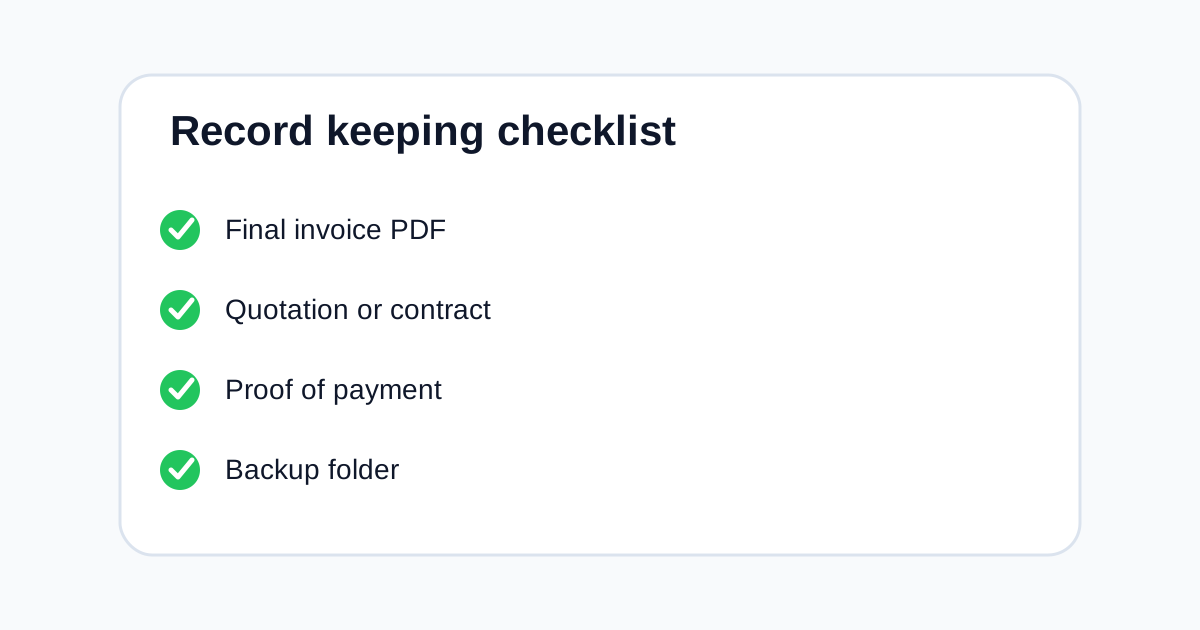
For each client project, consider a “project folder” that includes:
- Quotation (or proposal)
- Contract
- Work approvals
- Invoices
- Proof of payment
If you don’t want project folders, at least store your quotation number inside the invoice notes or reference field. Many businesses use a quotation generator to produce quotes with clean quote numbers, then reference that quote on the invoice so the paper trail is obvious.
Step 5: Backups and access
Two practical rules:
- Keep at least one backup (cloud drives usually do, but confirm)
- Limit access to financial files (especially if you have staff or contractors)
Invoices include personal information (names, addresses, sometimes bank details). Treat them as sensitive documents.
What you should keep for issued invoices (a practical checklist)
For your own invoices (money owed to you), keep:
- The final invoice (PDF)
- Any corrected versions (if you revised and reissued)
- A record of when it was sent and to whom
- Payment reminders (if relevant)
- Proof of payment (bank transfer confirmation, payment processor receipt)
- Any credit notes/refunds
If you invoice through a tool, export or save PDFs consistently. A browser-based invoice generator can help you create consistent invoices and keep numbering tidy, but you still want a clean archive so you’re not relying on a single system forever.
What you should keep for vendor invoices (business expenses)
For invoices you receive, keep:
- Vendor invoice
- Proof of payment
- Any receipts (especially for card payments)
- A note about what it was for, if it isn’t obvious
This matters most during tax time, when you’re separating business vs personal expenses, or when you need to justify a deduction.
When can you safely delete invoices?
If you follow a retention period (for example, 7–10 years), you can consider deleting or securely destroying older invoices after that period—but only if:
- You have no ongoing disputes or audits related to those years
- Your accountant confirms your retention obligations are met
- You’re comfortable you won’t need them for long-term warranty/contract reasons
Don’t just “trash” financial records
If you dispose of invoices, do it safely:
- Paper: shred
- Digital: delete from primary storage and ensure it’s removed from recycled/trash folders
If you store invoices in multiple places, you may need a periodic cleanup to avoid keeping sensitive data forever by accident.
Real-life scenarios (why this matters)
Scenario 1: freelancer gets asked to prove an old expense
A freelance consultant claims a software subscription as an expense. Two years later, during a review, they need the supplier invoice. They can show a bank statement, but without the invoice it’s hard to prove what the charge was for (and whether it was business-related).
Because they saved vendor invoices in a “Received/2024” folder with consistent filenames, they find it in 30 seconds.
Scenario 2: client disputes a line item after the project ends
A small studio finishes a project and invoices the final milestone. Months later, the client questions a specific line item.
The studio provides:
- The quotation they sent (with scope and pricing)
- The client’s email approval
- The invoice referencing the quotation number
The dispute ends quickly because the paper trail is clear.
Scenario 3: small business changes software
A trades business switches bookkeeping tools. The new accountant asks for prior-year invoices for reconciliation. Because invoices were stored in a simple year-based folder structure, the migration is straightforward and doesn’t become a month-long cleanup project.
A practical “record keeping” routine (15 minutes per week)
If you struggle with consistency, don’t aim for “one perfect day of cleanup.” Aim for a small routine you can do weekly.
Here’s a simple routine that works:
- Save any new vendor invoices you received this week
- Save PDFs for any invoices you issued
- Match payments received to invoice numbers
- Store proof of payment for larger transactions
- Flag anything missing (a vendor invoice you need to request, a client invoice that needs follow-up)
Doing this weekly prevents the end-of-year panic that many small businesses experience.
Where the invoice generator and quotation generator fit
If your current process is “write an invoice in a document, export it, and hope you can find it later,” the biggest risk is inconsistency: invoice numbers drift, filenames are random, and supporting documents get lost.
A simple invoice generator helps by standardizing invoice numbers, required fields, and PDF output. A quotation generator helps you keep quotes consistent too, which matters because quotes often become the reference point in disputes (“What exactly did we agree to?”).
Tools don’t replace good record keeping, but they can reduce the number of messy edge cases you have to deal with later.
FAQ
How long should I keep invoices for a small business?
Many small businesses keep invoices for 7 years as a practical baseline, and some keep them for 10 years for extra safety. The correct requirement depends on your country and tax system, so confirm with your accountant for your specific situation.
Do I need to keep both sent and received invoices?
Yes. Sent invoices show your income and what you billed clients. Received invoices support your business expenses and deductions. Keeping both gives you a complete financial record.
Are bank statements enough instead of invoices?
Usually no. Bank statements prove money moved, but invoices explain what it was for and who issued it. For tax and bookkeeping, invoices are often the primary supporting document.
Can I store invoices digitally, or do I need paper copies?
In many places, digital storage is acceptable as long as the record is complete, readable, and can be produced later. Some regions or industries may require originals for certain cases. If unsure, ask your accountant or local authority.
What should I store with an invoice to protect myself in disputes?
Store the quotation or proposal, the contract or scope agreement, approvals (emails/messages), delivery evidence, and proof of payment. The invoice tells what you billed; the supporting documents explain why.
What’s the best way to organize invoices so I can find them quickly?
Use a simple year-based folder structure and a predictable filename convention that includes invoice number, client/vendor name, and date. Keep everything in one “source of truth” location and back it up.
Should I keep invoices longer for large projects?
Often yes. Large projects, complex tax, international work, and anything with warranties or long-term obligations are safer to retain for longer periods.
When is it safe to delete old invoices?
Only after your retention period has passed and you have no ongoing audits, disputes, or long-term obligations related to that period. If you’re unsure, confirm with an accountant before deleting records.
Conclusion
Keeping invoices isn’t about hoarding PDFs—it’s about having a clear, defensible record when you need it. Choose a retention period you can live with (many businesses default to 7–10 years), store both sent and received invoices, and keep the key supporting documents that explain what was agreed and what was delivered.
If you want a simple way to create professional invoices, Quick Invoice Tool makes it easy to do that in minutes.