
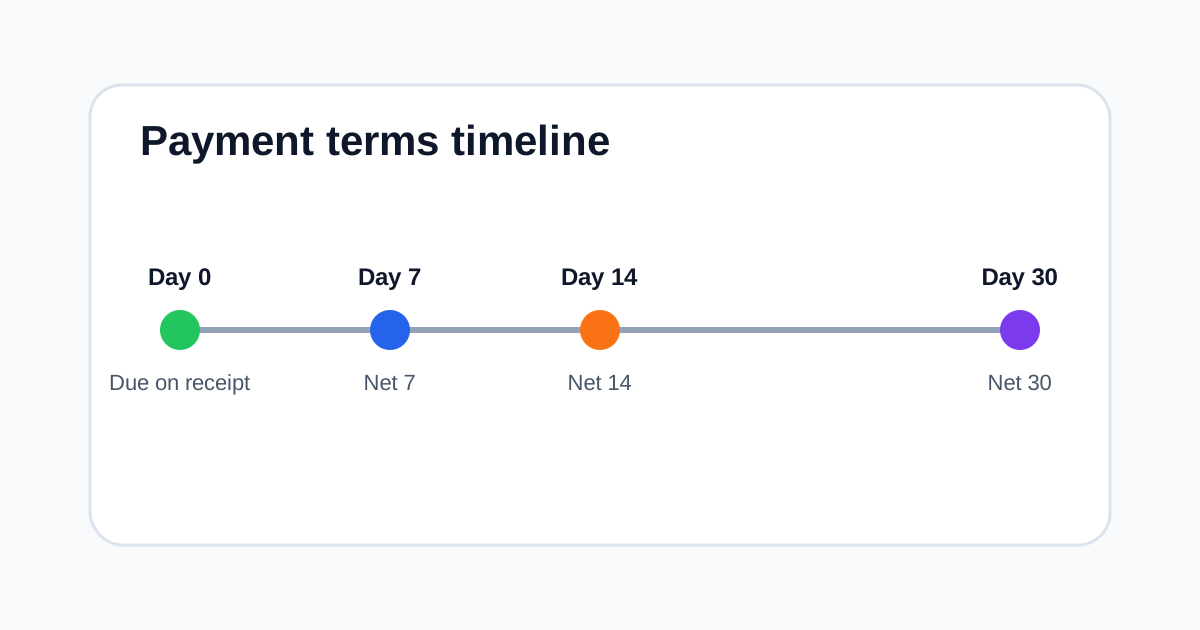
Payment terms look like a small line on an invoice, but they shape your entire cash flow. If your terms are unclear, you don’t really have terms—you have hope.
Most freelancers learn this the hard way. You send an invoice, your client says “Thanks!”, and then weeks go by. When you follow up, the reply isn’t “We’re not paying.” It’s usually something like “Finance runs payments once a month” or “Can you resend it to accounts payable?” or “We need a PO number before we can process invoices.”
So the question isn’t just “Should I use Net 7 or Net 30?” The real question is: what payment terms can you set that match how clients actually pay in 2026, while still protecting your time and cash flow?
This guide breaks down invoice payment terms for freelancers in plain language. You’ll learn what common terms mean, when each one makes sense, how to write them clearly on your invoice, and how to handle clients who push back. You’ll also get practical scenarios, wording examples, and a simple strategy for balancing speed and professionalism.
What are invoice payment terms?
Invoice payment terms are the rules you set for when and how a client should pay you.
Good payment terms answer four questions:
- When is payment due?
- How should the client pay?
- What reference should they use so the payment can be matched?
- What happens if payment is late?
For freelancers, payment terms are also a risk tool. They help you avoid carrying the full cost of a project for 30–90 days.
What “Net 7”, “Net 15”, and “Net 30” actually mean
“Net” terms are counted from the invoice date (unless your contract says otherwise).
- Net 7: payment is due 7 days after the invoice date
- Net 15 (or Net 14): payment is due 15 (or 14) days after the invoice date
- Net 30: payment is due 30 days after the invoice date
Simple example:
- Invoice date: 11 Jan 2026
- Net 14 terms
- Due date: 25 Jan 2026
In practice, you should always include an actual due date on the invoice. Many delays happen because “Net 30” is interpreted differently (30 days from invoice date, from receipt date, or from approval date). A due date removes ambiguity.
The payment-term decision most freelancers miss: how the client pays
Your terms can’t override a client’s internal payment process.
If your client only pays on the 15th and 30th, a Net 7 invoice sent on the 12th will probably be paid on the 30th. That doesn’t mean you shouldn’t set terms. It means you should set terms with reality in mind.
Two questions that prevent surprises:
- “Do you pay vendors on a set schedule (weekly/monthly)?”
- “Do you need a PO number, vendor form, or billing portal submission?”
If the client is large enough to have a process, your best move is to learn it early.
Common freelancer invoice payment terms (and when to use each)
Below are the terms freelancers use most often, with realistic pros and cons.
Due on receipt
Meaning: payment is due immediately.
When it works:
- Small one-off jobs
- Clients you already trust
- Work delivered on a tight timeline
Where it can backfire:
- Corporate clients that cannot pay immediately
- Clients who interpret “due on receipt” as flexible
If you use “due on receipt,” still add a date:
- “Due on receipt (11 Jan 2026)”
That simple line gives you something concrete to reference in follow-ups.
Net 7
Meaning: due in 7 days.
When it works:
- Small projects
- Retainers where the client expects frequent invoicing
- Clients who pay quickly and don’t have a long approval chain
Where it can backfire:
- Clients with monthly payment runs
- Clients that require invoice approval by multiple people
Net 7 is a good term when you want speed and the client can realistically meet it.
Net 14 / Net 15
Meaning: due in about two weeks.
When it works:
- Most freelancer relationships
- Clients with a light finance process
- Mid-sized projects where you want to be reasonable but not wait a month
Why it’s popular:
Net 14/15 is a practical middle ground. It gives clients time to process invoices but doesn’t leave you waiting too long.
Net 30
Meaning: due in 30 days.
When it works:
- Corporate clients
- Larger invoices
- Ongoing relationships where the client pays reliably (even if slowly)
Where it can hurt:
- New clients (higher risk)
- Projects that require you to carry costs (contractors, software, travel)
Net 30 is common, but it’s not automatically “professional.” It’s just common. If Net 30 creates cash-flow stress, protect yourself with deposits or milestones.
Net 45 / Net 60
Meaning: due in 45 or 60 days.
For most freelancers, these terms should be rare.
When they can make sense:
- Very large corporate clients with fixed terms
- Work that is truly low-risk (repeatable, low cost)
If a client asks for Net 60, don’t treat it as a normal request. Treat it as a negotiation point.
A practical alternative:
- Agree to Net 60 only with a deposit or milestone schedule
Deposits and milestones: the freelancer-friendly way to handle longer terms
A deposit doesn’t make you “difficult.” It makes you stable.
If you’re working with Net 30 clients, consider a deposit or milestone approach so you’re not carrying the entire project cost.
Common structures:
- 50% upfront, 50% on completion
- 40% upfront, 30% at midpoint, 30% on delivery
- Monthly invoicing for ongoing work
Real-life scenario: A freelance developer takes a 6-week project with a new client. The client insists on Net 30. The freelancer agrees, but uses 40/30/30 milestones. The client still pays on their cycle, but the freelancer’s cash flow stays healthy.
Retainers
For retainers, many freelancers invoice at the start of the period (for example, the first day of the month) with Net 7 or Net 14 terms.
This works because retainers are about reserving time. If the client pays late, the reserved time becomes unfair.
How to write payment terms clearly on your invoice
A good payment terms section is short, specific, and hard to misinterpret.
Include:
- Payment terms: Net 14
- Due date: 25 Jan 2026
- Payment method: bank transfer
- Payment reference: invoice number
Example wording:
Payment terms: Net 14
Due date: 25 Jan 2026
Payment method: Bank transfer
Reference: INV-2026-0019
If you accept multiple methods, list them clearly. If you accept only one method, make it obvious.
Late fees: should freelancers charge them?
Late fees can work, but only when they’re part of a consistent system.
Pros:
- Signals that deadlines matter
- Can motivate slow clients
Cons:
- Not always enforceable depending on your country/contract
- Can create tension if you don’t apply it consistently
A practical approach:
- Use late fees only for clients who repeatedly pay late
- State them in your contract and on your invoice
- Keep the language calm
Example:
“Late payments may be subject to a 2% monthly late fee.”
If you don’t plan to enforce late fees, it’s usually better to skip them and rely on consistent follow-ups instead.
What to do when a client asks for longer terms
This is where freelancing becomes negotiation.
Before you accept longer terms, ask yourself:
- Can you afford to wait this long?
- Is the client low-risk (reliable payer, established company)?
- Is the project structured so you can stop work if payment is late?
Then offer options:
Option 1: Keep the terms, reduce the risk
- “I can do Net 30 with 50% upfront and 50% on completion.”
Option 2: Keep the timeline, increase the price
Longer terms are a financing cost. Some freelancers price that in.
- “If terms need to be Net 60, I can do that with a 10% rate adjustment.”
Option 3: Decline politely
- “I’m not able to offer Net 60 at this time, but I can do Net 14.”
You don’t need to apologize for protecting your business.
The follow-up system that supports your terms
Terms only work if you follow up consistently.
A simple follow-up sequence:
- 3–5 days before due date: friendly reminder
- 1–3 days after due date: request confirmation of payment date
- 7 days after due date: escalate to accounts payable and pause future work if needed
Sample reminder (before due date):
“Hi Alex, quick reminder that Invoice INV-2026-0019 is due on 25 Jan 2026. Let me know if you need anything from me.”
Sample overdue message:
“Hi Alex, Invoice INV-2026-0019 is now past due. Can you confirm when payment will be processed?”
If you want a deeper guide, the article How to Handle Late Invoice Payments Professionally is the natural next read.
Real-world scenarios: choosing the right terms
Scenario 1: new client, fixed-fee project
A new client wants a $1,500 fixed-fee website audit. They ask for Net 30.
A safe approach:
- 50% upfront, Net 14 on the remaining 50%
This reduces your risk while still being reasonable.
Scenario 2: corporate client with strict Net 30
A corporate client can only do Net 30. They’re reliable, but their process is slow.
A practical approach:
- Net 30 terms, but invoice immediately at each milestone
- Confirm their payment run cutoff date
Your goal is to get into the next payment cycle, not to argue about the existence of the cycle.
Scenario 3: retainer client who pays inconsistently
A client is on a monthly retainer but pays late almost every month.
A practical approach:
- Invoice at the start of the month
- Net 7 terms
- Work pauses if payment is not received by the due date
This protects your time and keeps the relationship clear.
Where the invoice generator and quotation generator fit
Payment terms work best when your documents are consistent.
An invoice generator helps you show terms clearly (Net terms plus a real due date), keeps invoice numbering consistent, and produces a clean PDF that finance teams can process quickly.
A quotation generator helps you set payment expectations before work begins—deposit, milestones, validity period—so the invoice later matches what the client approved.
Tools don’t replace good boundaries, but they reduce the “admin mistakes” that cause avoidable delays.
Payment terms decision table
Use this table as a starting point before choosing invoice terms. It is not a rulebook, but it helps you avoid choosing terms only because they sound standard.
| Work situation | Practical terms to consider | Why it helps |
|---|---|---|
| One-off small project | Net 7 or due on receipt | Keeps small invoices from sitting unpaid for weeks |
| Medium freelance project | Deposit plus Net 14 balance | Protects cash flow while giving the client time to process |
| Corporate client with finance process | Net 30 with clear due date | Fits common approval cycles while avoiding vague wording |
| Monthly retainer | Invoice at month start, Net 7 or Net 14 | Keeps ongoing work funded before too much time passes |
| New or higher-risk client | Deposit, milestone payments, or shorter terms | Reduces exposure if the client delays payment |
Payment terms checklist before sending
- Write both the term and the exact due date.
- Make payment methods easy to find.
- Put deposit or milestone rules in the quotation before work begins.
- Avoid changing terms after approval unless the client agrees in writing.
- Save the final PDF and payment confirmation with your invoice records.
If you need a clean starting point, create the invoice in the invoice generator, use a matching quotation for agreed scope, and keep the final PDF with your records.
FAQ
What payment terms are best for freelancers?
Net 14 is a strong default for many freelancers because it’s reasonable and still supports healthy cash flow. Net 7 can work for smaller jobs. Net 30 is common for corporate clients, but freelancers often pair it with deposits or milestones.
Is Net 30 standard for freelancing?
It’s common in corporate environments, but not automatically “standard” for freelancers. Many freelancers use Net 7–14 for smaller clients and projects.
Should I include a due date if I already wrote “Net 14”?
Yes. A specific due date removes ambiguity and makes follow-ups easier.
Can I change payment terms after a client accepts a quote?
You can, but it should be agreed in writing. The easiest approach is to set terms in your quote or contract before you start.
What if a client refuses deposits?
You can offer alternatives (milestones, smaller scope, shorter engagement) or decide whether the client is too risky. Deposits are not about trust; they’re about cash-flow protection.
Should I charge late fees?
Only if you’re prepared to enforce them and they’re permitted in your jurisdiction. Consistent follow-up is often more effective than a late-fee clause you never apply.
How do I enforce my terms without sounding rude?
Use calm, factual reminders and consistent process. Don’t argue. Ask for a payment date, and pause future work if needed.
What’s the best day to send invoices?
Send invoices immediately after delivery or at the start of a billing period. For clients with payment runs, send early enough to hit the next cutoff.
Conclusion
The “best” invoice payment terms for freelancers depend on two realities: your cash flow needs and how your client pays. Net 14 is a practical default for many freelancers, Net 7 can help for smaller jobs, and Net 30 is often unavoidable with corporate clients—so protect yourself with deposits, milestones, and clear invoicing.
If you want a simple way to create professional invoices, Quick Invoice Tool makes it easy to do that in minutes.